
 German
 Chinese
Perspectives from Academia, Business, and Practice
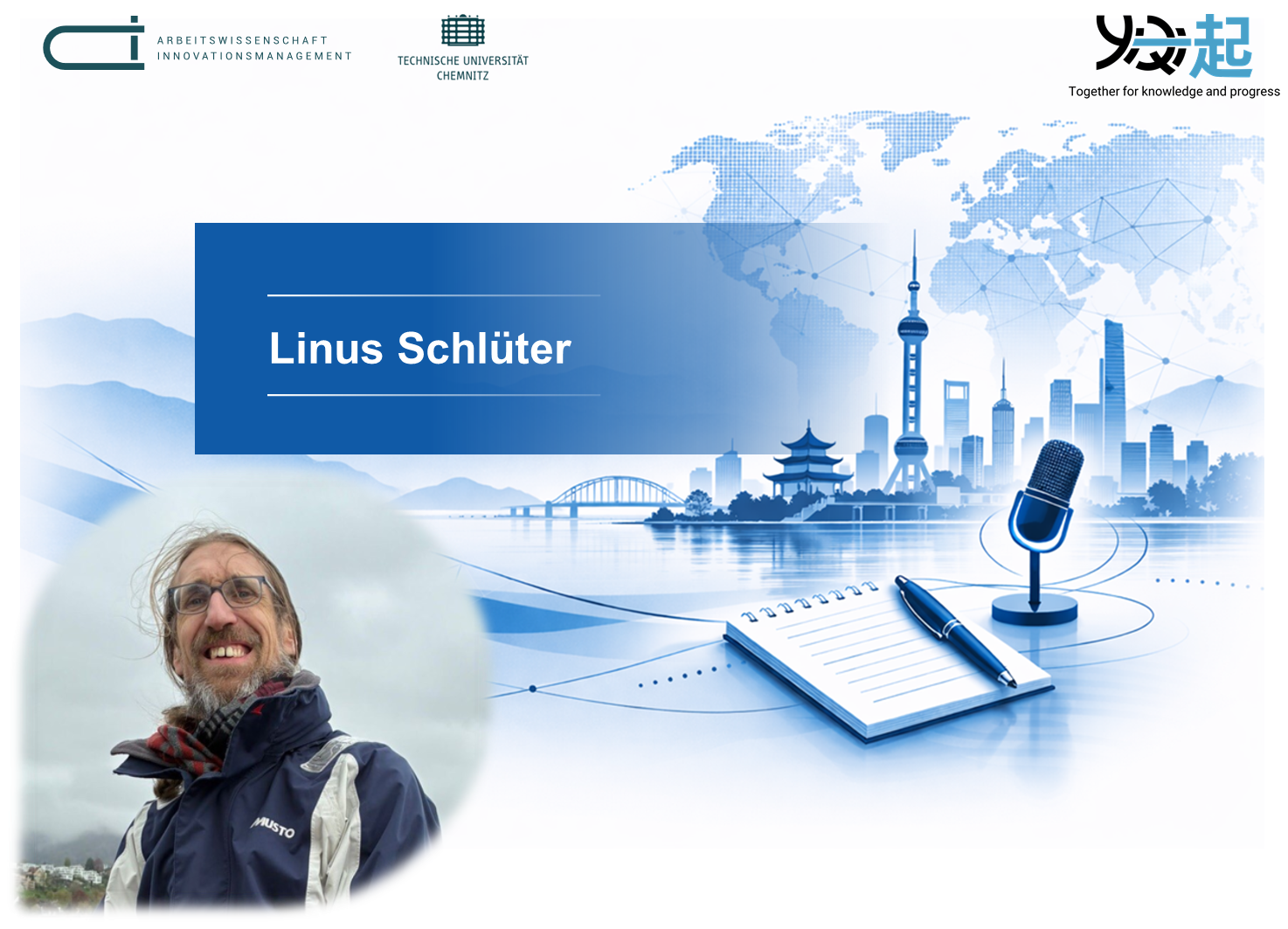
Briefly introduce yourself: Who are you, what do you do professionally, and what is your connection to China?
My name is Linus Schlüter, and I studied Religious Studies and Chinese Studies. Professionally, I had many years of contact with China as a tour guide for adventure travel, where my role was to introduce visitors to the country and its people. I then worked for more than a decade as a cultural and language mediator at a Confucius Institute before taking on the task of building regional China competence for universities and research institutions in Thuringia in September 2023.
What has been your most important personal or professional experience in working with China?
I have been engaged with China since 1996 -almost 30 years now- so there have been many experiences, both very positive and others that made me angry or left me feeling excluded as a foreigner.
On the positive side, there was one linguistic experience in particular: I heard a sentence and did not think that I had misunderstood it. My first reaction was, "How can anyone think like that?" Only later did I manage to unravel the idea and worldview behind it. For me, this experience symbolizes what it means to immerse oneself in a different way of thinking and living. Being able to engage with that world - to reorient and readjust oneself, to see the world and humanity from a different perspective, to understand it and act within it—is what gives me great joy in China and in the Chinese language.
On the other hand, there are recurring misunderstandings and challenges. I experienced people calling after me "laowai," leaving me out of conversations, either because I was assumed not to be linguistically competent enough or because I was seen as a "Westerner" who could not be expected to respond appropriately to the requirements of socialism with Chinese characteristics and therefore should not be involved in what were considered "internal affairs."
The distinction is between zhong (中), meaning "middle" or "China," and wai (外), meaning "outside" or "foreign." A Chinese person in Germany is still referred to as Chinese in the Chinese language, while I, as a German, continue to be described as a foreigner—even though we are in Germany.
These are situations that make me angry and diminish my enthusiasm for China.
Why do you think China is an important partner today - academically, economically, or scientifically?
If I put on my hat as a Sinologist, research about China is certainly possible, but ultimately I want to engage with China itself. For that reason, having access to the country and its people is highly important.
From an economic perspective, China is, on the one hand, a major market for German companies, where many have earned considerable profits and made substantial investments. On the other hand, many products manufactured in China are sold here. In addition, Chinese companies have themselves become investors in Germany. The establishment of the battery manufacturer CATL in Thuringia is one example, creating jobs in the region.
In research and academia, China has developed excellent research institutions through excellence initiatives and talent recruitment programmes, as well as generously funded research schemes. There is knowledge available there that we do not yet possess ourselves, or that would require considerable time and expense to develop independently. I would therefore like to see a more strategic approach to partnerships with China: Where are the outstanding researchers? To which institutions should we send visiting scholars? This is something I would hope for from a national competence platform, similar to the "science and technology diplomats" (科技外交官) established by the Chinese side.
What distinguishes cooperation with Chinese partners most strongly from other international collaborations?
I cannot really answer that, because so far I have only worked with China. In general, however, I think that one important difference lies in the conditions of a state in which one political party fundamentally claims the leading role and, through parallel structures, ultimately always has the final say.
What typical challenge keeps recurring in cooperation with China?
I cannot really say, because it always depends on the specific context.
Was there a particular situation or misunderstanding from which you learned a great deal?
There have been too many situations, all of which fit together like pieces of a puzzle to form a larger picture. I believe I have stepped into many cultural pitfalls, and they all seem equally significant to me.
One anecdote I like to tell is about going to a German restaurant for a Christmas dinner with several Chinese fellow students. Everyone shared and sampled each other's dishes—except me. I was the spoilsport who simply wanted to enjoy my own meal, did not want to try the others' dishes, and was equally unwilling to share mine. At the time, I did not understand why they did this, and I believe the Chinese side equally failed to understand why I refused to join in.
What do you wish you had known before beginning your first cooperation or research stay in China?
I travelled to China for the first time completely naively and without the slightest idea of what to expect. It was still the 1990s, and as I remember it, almost every question I asked was answered with 没有 – "there isn't any" or 不行 – "that's not possible".
Looking back, it would have been helpful to know how strongly the feeling of not being able to communicate or act effectively would affect me, and what strategies exist to regain a sense of agency.
In your view, which competencies or preparations are essential for successful cooperation with China?
Personally, I believe that language skills and cultural competence are essential on both sides. The Chinese side needs an understanding of Germany - a Germany competence - and the German side needs China competence. In business, numbers matter; for engineers, it is formulas and material properties. Put simply, these are "culture- and language-free."
How has exchange with China changed in recent years—scientifically or culturally?
I believe that the hope of achieving change through trade has not materialized and that China has become a more self-confident partner that increasingly seeks to shape the rules of engagement. In addition, with Xi Jinping's third term in office, China has once again taken on Maoist characteristics, where the primacy of the Party line takes precedence. As a result, Chinese citizens themselves have less room for independent action. The measures taken during the COVID-19 pandemic demonstrated to every Chinese citizen that the arbitrariness and power of the state could affect anyone.
What is the one key insight or recommendation you would like to share with other researchers?
Cooperating with Chinese partners is exciting and rewarding, but you will be operating outside your comfort zone. You will face pressure to justify your decisions and be exposed to reputational risks. If the Party line changes, this may bring a project to an abrupt end.
Only engage in such cooperation if you have defined clear exit criteria—and if you enjoy adventure. The experiences will stay with you for a long time, and they will enrich your life.