
 German
 Chinese
Perspectives from Academia, Business, and Practice
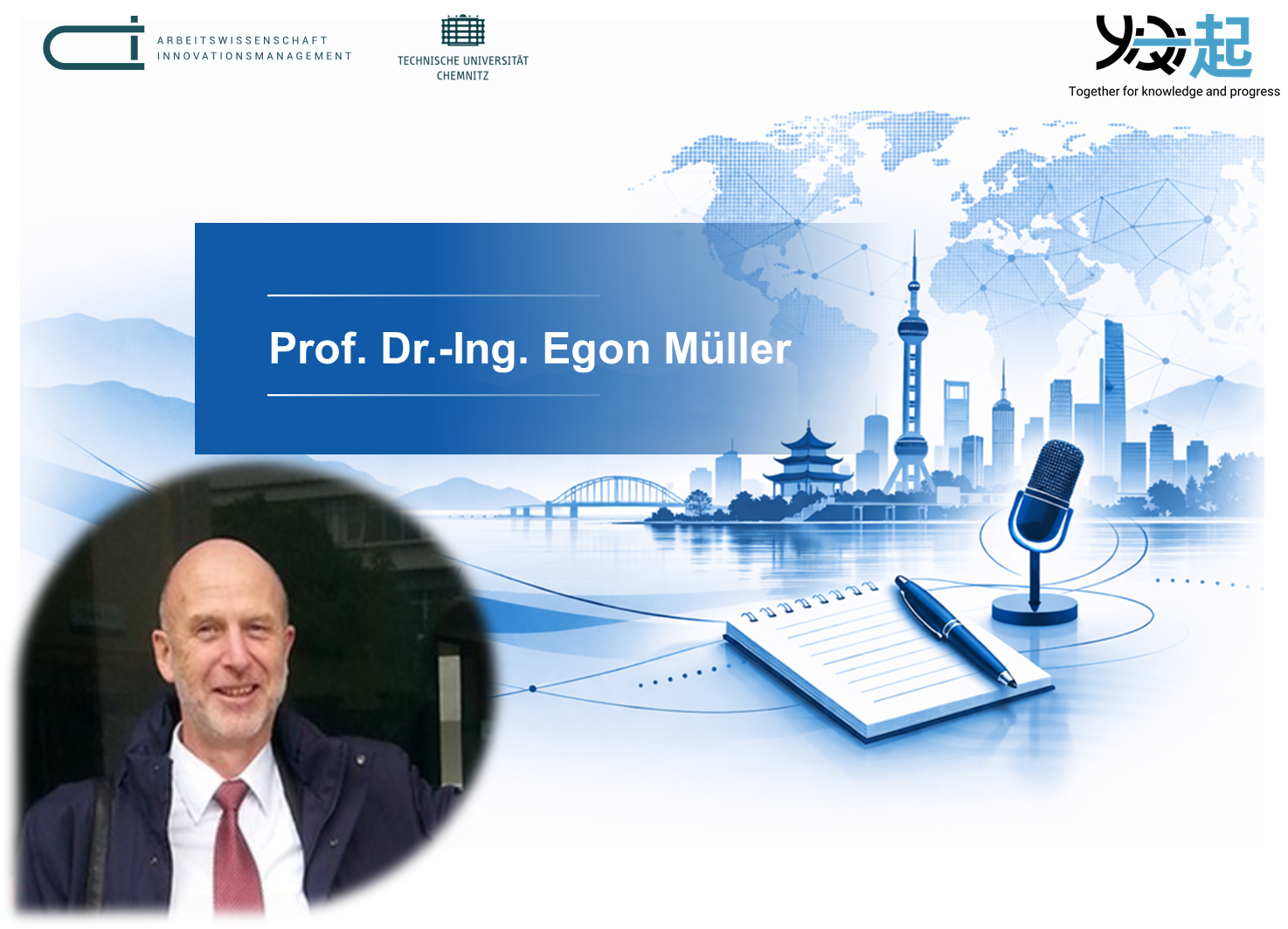
Could you briefly introduce yourself? Who are you, what do you do professionally, and what is your connection to China?
My name is Prof. Dr.-Ing. Egon Müller, and for many years I served as Professor of Factory Planning and Factory Operations and as Director of the Institute of Industrial Management and Factory Systems at Chemnitz University of Technology. Prior to that, my academic career included studying mechanical engineering, earning my doctorate, and holding a professorship at the University of Applied Sciences Zwickau. I also served for several years as Chairman of the Committee on Industry and Foreign Trade of the Zwickau Regional Chamber of Commerce and Industry. Since my retirement in 2018, I have remained affiliated with Chemnitz University of Technology.
My connection to China goes back around 30 years and has been both professional and personal. Over the years, I have developed numerous contacts in teaching, research, and collaboration with industrial companies. In particular, academic exchange and economic cooperation with Chinese partners have been an important part of my work for many years. I also had family ties to China for almost a decade, which gave me the opportunity to get to know the country in depth not only from a professional perspective but also on a personal level..
What was your most important personal or professional experience working with China?
One of the most formative aspects of my experience working with China has been the great respect shown for academic achievements, professional expertise, and personal life experience. I have repeatedly encountered this strong emphasis on seniority in my work with a wide range of Chinese partners.
Over the years, I have served several times as an invited professor at Chinese universities and, through the Chinese central government’s High-Level Foreign Expert Program, had the opportunity to spend extended periods at various universities in China. From 2019 to 2022, I also served as Chief Scientist of the 5G-Based Intelligent Platform at the Haier Institute of Industrial Intelligence. Another particularly rewarding aspect of my work has been supervising Chinese doctoral students in Germany, whom I found to be exceptionally dedicated, highly skilled in their fields, and strongly motivated in their academic work.
Why do you consider China a relevant partner today - professionally, economically, or academically?
Throughout the entire period of my collaboration with Chinese partners, various fields have been strategically developed with a long-term perspective. Economically, the “Made in China 2025” strategy has been consistently implemented and systematically further developed for more than ten years. Initially, in many areas, it corresponded to the Industry 4.0 approach of Germany’s High-Tech Strategy. Today, however, China is significantly ahead in certain fields, such as artificial intelligence, humanoid robotics, automation, and renewable technologies.
Similar developments can also be observed in the higher education and research system. The strategic orientation there has been relentlessly performance-driven (with the Gaokao test being an indispensable prerequisite for admission to higher education) and equally relentlessly focused on STEM subjects in order to implement the economic strategy.
Today, these developments create opportunities for genuine win-win situations in high-level academic and economic cooperation. In my view, the era of a rather “teacher-like” approach to cooperation from the German perspective is long gone.
What distinguishes collaboration with Chinese partners most strongly from other international collaborations?
Based on my personal experience, I would say that there are considerable differences compared with other international collaborations, particularly in terms of approaches that are generally less structured. This also applies to academic collaboration, but is especially pronounced in the economic context. The success of economic cooperation is often strongly shaped by personal relationships between the partners on both sides. Actions and decisions on the Chinese side are strongly influenced by dominant and pronounced hierarchical leadership. This plays an extremely important role and should definitely be taken into account in coordination processes and when making agreements.
If organizationally possible, efforts should also be made to involve a trusted Chinese person who does not directly belong to the respective partner organization. In addition, it is helpful not to limit communication exclusively to English.
What typical challenge repeatedly arises when working with China?
The importance of communication outside the official part of discussions and negotiations in China is often completely underestimated. The business meal that usually accompanies such meetings can play a decisive role in the successful outcome of discussions and negotiations, sometimes even more so than reaching agreement and mutual understanding on the actual content. In this context, the completely different cultural and historical background of the development of the People’s Republic of China and its society should always be taken into account.
Decisions are often made ad hoc by the responsible individuals, but can take a very long time when official authorities are involved. In this context, it is also possible to suddenly find oneself dealing with different responsible contacts.
Was there a situation or misunderstanding from which you learned a particularly valuable lesson?
It cannot be ruled out that, particularly in academic collaboration, Chinese individuals involved may develop expectations of personal support.
What do you wish you had known before starting your first collaboration or research stay in China?
Because I had the opportunity to gradually gain experience through my many stays over the course of many years, I cannot explicitly identify any particular aspects now.
What skills or preparation do you consider essential for successful collaboration with China?
In my view, it is particularly important for successful collaboration with China to acquire a basic understanding of the country’s historical, social, and cultural development. Relying exclusively on general public perceptions is not very helpful and, in the worst case, can even be detrimental to collaboration.
It is equally important to familiarize oneself with the current status and level of the various institutions in China. Anyone wishing to collaborate successfully with Chinese partners should obtain specific information in advance about the respective institutions and their academic and scientific expertise.
How has exchange with China changed in recent years - academically or culturally?
In my view, exchange with China has changed significantly in recent years. In earlier years, there was an unreserved admiration for German achievements in almost all fields. However, as a result of the strategic developments already mentioned, this relationship has fundamentally changed. Today, China is often not only on par with Germany, but ahead in many fields. This development is also reflected in significantly increased self-confidence on the Chinese side, both institutionally and socially.
I also experienced this in personal encounters. On several occasions, Chinese students told me quite naturally and without being asked that they were proud to be Chinese. In my view, this increased sense of national identity now shapes many forms of collaboration and exchange.
What is the one key insight or recommendation you would give to other researchers?
Today, one must assume that most discussions, topics, and projects should be conducted on an equal footing and that the Chinese partners are aware of this.